

Website chat can involve personal information even when you do not require visitors to register. A person may type a name, order detail or private question, while the service also handles conversation identifiers and connection metadata. Privacy work therefore starts with the actual deployment, not a badge declaring that a widget is automatically compliant.
This guide is a practical inventory and review aid for AddFreeChat. It is not a completed privacy notice, data-processing agreement or legal opinion for your business. Determine the rules that apply to your organisation and customers, distinguish EU and UK requirements, and obtain appropriate legal review before relying on a particular lawful basis or publishing contractual promises.
1. Map the information the service actually handles
List visitor messages, conversation identifiers, presence and read state, ratings and any private support notes. Account information is a separate category: a no-email key account still has identifiers and authentication records. Optional recovery email and authenticator settings introduce additional account-related information.
Include connection and operational data in the inventory. Website servers, signalling services and relays can process network metadata, and logs have their own access and retention arrangements. Do not describe technical identifiers as anonymous merely because they are not a visitor’s full name. Assess whether they can relate to an identifiable person in context.
Keep the inventory specific to enabled features. A text-only deployment differs from one offering calls and file transfers. The basic embed does not automatically read commerce orders, booking records or authenticated member data. If a later connector adds those flows, update the inventory and review before treating the old notice as sufficient.
2. Describe storage and media truthfully
AddFreeChat stores text conversations and relevant application records on its hosting environment. HTTPS protects transport, but that should not be rewritten as a claim that all stored text is end-to-end encrypted or that every backup has independently verified encryption. State only the protections actually established for the deployment.
Browser calls use WebRTC and may use an authenticated relay when a direct path is unavailable. The current call workflow does not record audio, video or screen sharing. That does not prevent a participant from independently recording through another tool, nor does it mean the service handles no connection metadata.
Chat-file uploads to server storage are disabled in the current implementation. File sharing uses recipient-accepted browser-to-browser transfer with temporary browser-memory copies and expiry. A relay may carry encrypted transfer traffic, and a recipient’s downloaded copy remains on their own device. Avoid the overbroad claim that no information ever passes through a server or can exist after the transfer.
3. Identify purposes, roles and lawful basis
Write down why each category is needed: answering a support question, maintaining an account or protecting the service from abuse are different purposes. Assess the appropriate legal basis before processing and document the decision through your reviewed business process. Do not assume that using a chat widget automatically selects consent or legitimate interests for every activity.
Establish the relevant controller and processor relationships, supplier terms, subprocessors and any international-transfer arrangements. Verify hosting and mail locations from the actual provider records. Do not infer a legal entity, processing region or contractual safeguard from a domain name or an IP address alone.
The ICO’s UK guidance was updated in 2026 following changes in UK law. Older summaries may use outdated lists or terminology. EU guidance and UK guidance should be read in their respective contexts rather than merged into a single unsupported statement about every jurisdiction.
4. Make privacy information easy to find
Explain the actual purposes, relevant recipients, retention approach and contact route in clear language. The ICO’s transparency guidance emphasises providing privacy information when collecting information from individuals. A notice that visitors cannot find, or wording copied from a different product, is not a good description of this deployment.
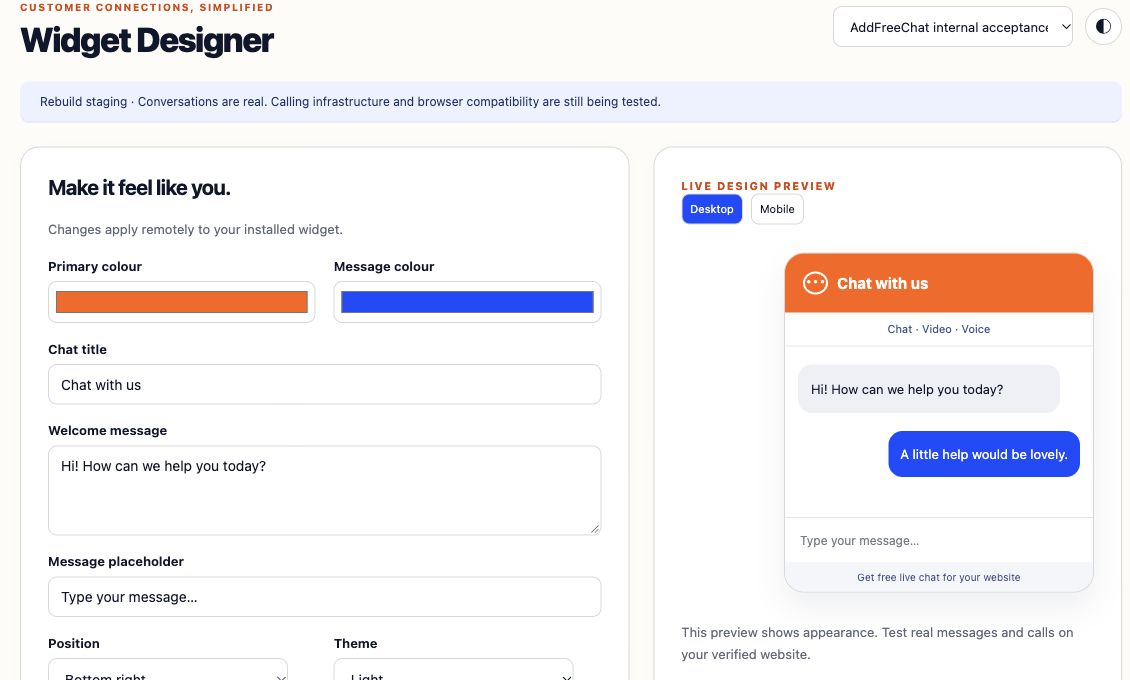
Use Widget Designer’s privacy wording to discourage passwords, full payment details and unnecessary sensitive information. Keep it concise and connect it to the business’s fuller reviewed information through the appropriate website presentation. Do not pretend that a brief warning replaces the complete transparency work.
Review what agents ask. A sizing question rarely requires a home address, and a technical error screenshot can often be cropped to remove unrelated content. Data minimisation is an operational habit as well as a configuration choice. Train staff not to request secrets simply because they would make troubleshooting easier.
5. Review browser storage and consent separately
The loader uses browser storage for conversation recovery. Storage-and-access rules can apply beyond traditional cookies, so inventory the actual browser keys and purposes rather than checking only a cookie banner’s list. Third-party advertising or analytics, if later introduced, requires its own assessment.
Do not assume every chat-related storage purpose is exempt because support is useful to the business. The ICO’s current exceptions guidance distinguishes what is essential to a service the user requests from broader business convenience. Assess the specific deployment and obtain review where needed, including what happens before the visitor opens chat.
Test the consent manager’s actual choices. If a script is withheld, check that the website explains the resulting support limitation and offers a suitable alternative. Do not add a second unconditional integration that silently defeats the chosen control.
6. Limit access and keep retention realistic
Give staff individual accounts and website roles matching their responsibilities. Review memberships and unused invitations when people leave or change duties. An agent’s chat access is not permission to inspect every private business record, and the basic widget does not create those connectors automatically.
The current conversation-retention setting defaults to ninety days and supports a configured range of seven to seven hundred and thirty days. Scheduled cleanup removes eligible expired records in bounded work. Choose a period based on reviewed need, and do not describe a configured deadline as proof that every backup and log is immediately erased at the same moment.
Account export, session revocation and the delayed account-deletion workflow are product tools, not a complete legal-rights process by themselves. Understand what each export contains, which records belong to another person and how backup retention is handled. Do not equate the account-deletion delay with a universal statutory response deadline.
7. Prepare rights, incidents and change review
Use a documented contact route for privacy requests and a proportionate identity-check process. Review the requested information before disclosure so another person’s data is not exposed. EDPB guidance provides useful background on individuals’ rights and the need to consider others when supplying copies.
Maintain an incident process and a supplier contact list appropriate to the business. Test restoration and retention procedures rather than relying only on a successful backup job. Describe off-server recovery as proven only after the relevant backup and restore acceptance has actually passed.
Revisit this review when enabling a new channel, connector, recording feature, marketing system or hosting region. A useful privacy description follows the real service as it changes. Keep unverified contractual and compliance claims out of the published website until the relevant evidence and professional review are complete.
A practical review exercise
Before launch, walk through one harmless test conversation and mark every place it appears: the visitor browser, support inbox, exported transcript and any deliberately requested email copy. Compare that observation with your inventory. If the notice says a copy is never stored while your own test produces a retained transcript, correct the claim before publishing it.
References and review notes
Platform instructions reviewed on 27 November 2026. Builder-specific steps follow the linked official documentation and still require testing on your own published site.