

Live chat can help a shopper resolve uncertainty while considering a product. It cannot make an unsuitable product suitable, remove an unexpected delivery cost or guarantee that a conversation turns into a sale. The useful question is which real shopping problems your team can solve and how you will tell whether the change helped.
This guide uses AddFreeChat as the support channel and keeps measurement separate from the sales pitch. The basic embed does not automatically read baskets, synchronise orders or attribute purchases to conversations. Start with a concrete hypothesis, provide accurate help and evaluate the whole shopping journey with evidence you actually have.
1. Choose one uncertainty worth addressing
Review recurring questions from customer conversations, search enquiries and your existing service records. Look for a problem that an agent can genuinely clarify: sizing, compatibility, product contents or how a published delivery rule applies. Choose one narrow task rather than announcing that chat will improve every part of the shop.
Write the hypothesis in plain language. An example is: “Shoppers cannot tell whether this fitting works with model A, so a clear answer and compatibility link may help them choose.” This is an illustrative planning example, not a measured AddFreeChat customer result. Keep the distinction explicit in internal reports.
Decide what a good outcome looks like for the shopper. Sometimes the correct answer is that the item will not meet their needs. Helping them avoid a mistaken purchase can reduce future frustration even when it does not increase an immediate conversion count. Do not encourage agents to promise a fit they cannot establish.
2. Put accurate information on the product page
Before relying on agents to answer the same question repeatedly, improve the public product information. Add an understandable compatibility explanation, size guide or contents list where appropriate. Chat should help with remaining uncertainty, not conceal a page that never explains the basic offer.
Give agents the same authoritative source. A saved reply can link to the published guide and explain how to use it, but it should not contain a separate contradictory rule. When the product or policy changes, update both the page and the support material through a clear owner.
Avoid unsupported urgency, delivery promises or invented customer-success statistics. A quick confident answer is harmful if it is wrong. State what you can confirm and what needs checking, and keep the visitor informed when a specialist or supplier response is required.
3. Make the widget useful without interrupting buying
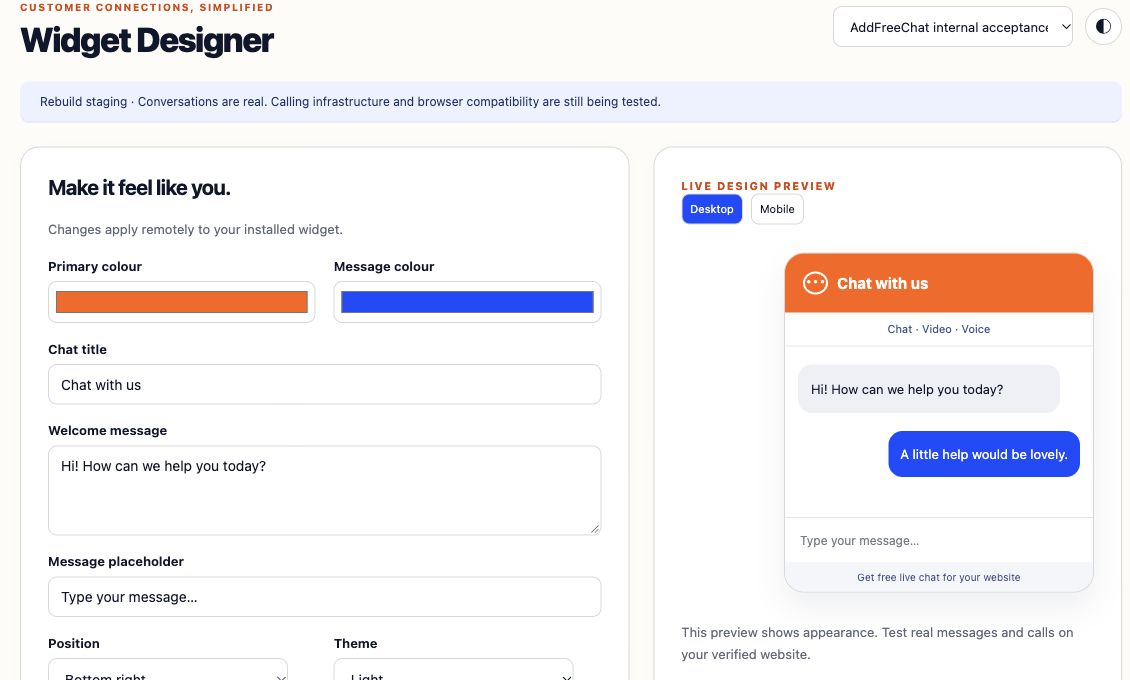
Install AddFreeChat on the verified storefront and complete the two-way message test. In Widget Designer, use a specific welcome such as “Ask us about fit or delivery.” Position the launcher so it leaves product choices, purchase buttons, cookie controls and mobile navigation usable.
Start with text messaging and realistic coverage hours. Offering extra call channels is worthwhile only when the team can use them effectively. A camera call may help demonstrate a physical item, but it adds device and network requirements that a simple sizing question may not need.
Use searchable help for recurring public information and quick replies for common opening questions. A suggested reply fills the visitor’s composer for review; it is not proof that the system detected a basket or predicted an abandoned order. Describe the supported interaction accurately.
4. Prepare a concise answer workflow
When a shopper asks, identify the intended use and the minimum detail needed to answer. For compatibility, ask for the model rather than immediately collecting a home address or order history. Link to the relevant public information and explain the next step in a few clear sentences.
Keep a named agent responsible for the conversation. If another person must check a detail, leave a useful private note and hand over through the team workflow. Do not make the shopper repeat the whole story because the first agent did not record what was already established.
Respect boundaries around private orders and payment. The basic chat installation is not an order-verification connector. Use your existing authorised commerce tools and identity-check process, and keep payment credentials in the secure checkout flow. An agent’s wish to help does not justify collecting unnecessary secrets.
5. Decide what you will measure before changing the site
Define a period, relevant pages and the support change you are testing. Record any other changes likely to affect results, such as stock availability, advertising campaigns, discounts or shipping prices. Without that context, a movement in sales can be wrongly credited to chat.
AddFreeChat’s reports describe support activity, including conversations, messages, ratings and a bounded first-reply measure. They are not a complete ecommerce attribution system. Use your established commerce analytics for purchase outcomes, with the appropriate privacy and consent treatment, and avoid claiming that a chat count proves a sale.
Do not compare people who chose to chat with everyone who did not and call the difference a causal uplift. Those groups can differ before the conversation begins. A controlled test may be useful when you have sufficient traffic and a suitable measurement process, but low traffic should lead to cautious conclusions rather than manufactured precision.
6. Use operational evidence while traffic is small
For a new shop or low-volume page, review whether questions are answered accurately, whether customers find the linked guide and whether the same confusion recurs. Record examples without unnecessary personal data. These observations can improve the service even before you have enough transactions for a stable conversion analysis.
Track a small set of actionable issues. For example, several people may misunderstand a measurement label or fail to find the returns page. Fix the source of confusion and observe whether the question continues. Do not treat fewer chat messages as automatically good or bad; it may mean clearer information or a less discoverable support route.
Use ratings as one input, not an absolute verdict on staff. A low rating can reflect a policy the agent cannot change, and a high rating does not establish that every factual statement was correct. Review conversation quality and the customer’s eventual task outcome alongside the numeric signal.
7. Keep checkout and mobile usability in the review
Test the storefront at narrow width with the widget open and the keyboard visible. A support button that covers Add to cart can undermine the journey you hoped to improve. Check product variants, basket drawers and primary controls after theme changes.
Keep checkout boundaries clear, particularly on hosted commerce platforms where a storefront script does not control checkout extensions. Do not attempt to inspect protected payment fields or bypass platform restrictions. Give the shopper a clear support path before and after the protected payment stage.
Baymard’s checkout research is a useful reminder that abandonment has multiple causes and that not every browsing session is ready to purchase. Use that context to avoid promising that live chat alone will recover every lost order. Fix structural price, usability and policy problems at their source.
Turn learning into a maintained service
Review the chosen hypothesis after the defined period, state what was observed and record what remains uncertain. Keep any measured purchase result separate from illustrative examples and support counts. Update help answers and product information when the evidence points to a recurring gap.
Useful live chat supports a better buying decision through accurate information and an easy conversation. Its contribution should be assessed honestly, with a clear support process and measurement method rather than a guaranteed percentage in the marketing headline.
References and review notes
Platform instructions reviewed on 27 November 2026. Builder-specific steps follow the linked official documentation and still require testing on your own published site.